

Traces of Being
Rather than relying on direct figurative portraits, my exhibition “Traces of Being” explores how identity can be represented through absence, objects, personal items without directly showing the human face.The exhibition focuses on the idea that a trace can be an accidental footprint, shadow, or leftover object from someone's life. Through themes of trauma, survival, memory, and loss, the artwork shows that a person’s identity can still remain present even when their physical body is absent. Instead of the traditional portrait of someone, these artists use objects,material and as well as showcasing history through traces to create stories and something we can interpret ourselves. This concept connects to art critic Hal Foster who says that artists use everyday objects, materials and personal leftovers to show history and memories. He explains that these hidden clues let us connect with a story even when no person is actually there. In this gallery, ordinary materials are transformed into meaningful traces of someone's life and history through things such as shadows, old shoes, words on chairs, a big pile of candy and an unmade bed. Each artwork allows the viewers to experience a person's experiences or story indirectly. The exhibition takes the visitors on a step by step journey from starting with a big historical issue and moving down to personal items you would find in a bedroom. It opens up with Kara Walker’s Insurrection!, where the cut out silhouettes and real shadows cast on the wall connect people today to historical violence without showing any faces or portraits, showing a trace of themselves while experiencing history. The absence of faces emphasizes how historical trauma can affect those whose story may be lost. Next is Doris Salcedo’s Atrabilarious which uses old shoes inside a wall to represent people who went missing during political conflicts. This shows how everyday objects can carry the weight of someone’s life, as well as traces of lives
Artworks
- My Bed,Tracey Emin, bedding (1998) — Tracey Emin art piece is her own unmade stained bed that is surrounded by everyday personal clutter and trash. Created in 1998 it shows her lifestyle of what she was dealing with at the time. The messy arrangement of the rumpled sheets, the empty beer bottles as well as the cigarette boxes create a texture that contrasts sharply with the white clean walls. By leaving out her own physical body in this, Emin leaves behind an unintentional trace of severe mental and personal breakdown. Our eyes capture the uneasy feeling and sensing what is going on without anyone telling us what happened. This installation shows the exhibition theme by showing that the human identity and history can be showcased through the messy residue that is left behind.
- Insurrection! (Our Tools were Rudimentary, Yet We are Pressed on), Kara Walker, cut-paper silhouettes (2022) — Kara’s Walker installation shows a bunch of black paper silhouettes of 19th century figures acting out scenes on a white wall which is being projected by an overhead projector. This piece incorporates visitors as the shadows are shown directly onto the scene. The high contrast between the dark shapes and the bright light strips away the facial features to make us focus entirely on body movement and the poses. This was created in 2002 to show antebellum slavery in the American South, as the silhouette cutouts act like a historical clue and makers. By throwing real audience shadows onto the wall, Walker connects present day viewers to past struggles. Overall the work uses the absence of facial features and the usual self portrait to show how shadows can leave a lasting trace of historical violence and can even teach the viewers what was going on back then.
- The Chase, Julie Gough, Installation / mixed media (2008) — Julie Gough constructed a sculpture of a 19th century European leather seat resting on four fragile tree legs, with tiny silver steel pins that spell out an 1830 newspaper which talks about hunting indigenous people. The story is laid out across the leather seat and the dark leather as well as the worn out one, creates a visual tension against the real legs. This was created in 2008 and the piece resembles historical reports of colonial settlers attacking Indigenous people. By placing a heavy seat on top of a fragile leg, Gough visually shows the destructive nature of the colonials onto the people and landscape. The text on the seat with the pins turns an ordinary seat to one that has history and tells how a domestic object can carry traces of historical trauma without there being anyone around.
- Atrabilarios, Doris Salcedo, Drywall and shoes (1992) — Doris Salcedo’s Atrabiliarious shoes are five pairs of worn women's shoes placed inside an opening in the wall covered in a cloudy like material. The dark and worn shoes contrast against the lighter wall while the repeated placements of the shoes creates a pattern that makes the viewer look at each one. The shoes are partially hidden from us and create a sense of absence because we can sort of see the shoes but we can’t see the people who wore them. Salcedo created this artwork to show the people who disappeared during the violence and conflict in Columbia using personal shoes that were theirs. All in all, the overall goal of the piece is to show how ordinary personal objects can become a trace of someone's identity and existence even when the person themselves are not in the picture.
- ”Untitled”(Portrait of Ross in L.A),Felix Gonzales-Torres, endless supply of candy (1991) — Felix Gonzalez-Torres showcases a 175 pound pile of colorful wrapped candy into a corner of a gallery. This invites visitors to take pieces from the pile. The reflective and multicolored wrappers and the pile shape of the spill contrast well with the white background walls. Created in 1991 during the height of AIDS and HIV, as a memorial to his friend Ross.The specific 175 pound weight shows the physical trace of his partner's body, and the taking and refilling of the candy shows the physical loss as well as the memory left behind from his friend. Without showing a portrait of a human face or body, Gonzales shows that physical weight and the visitor's interaction can leave a message as well as a trace of personal identity.
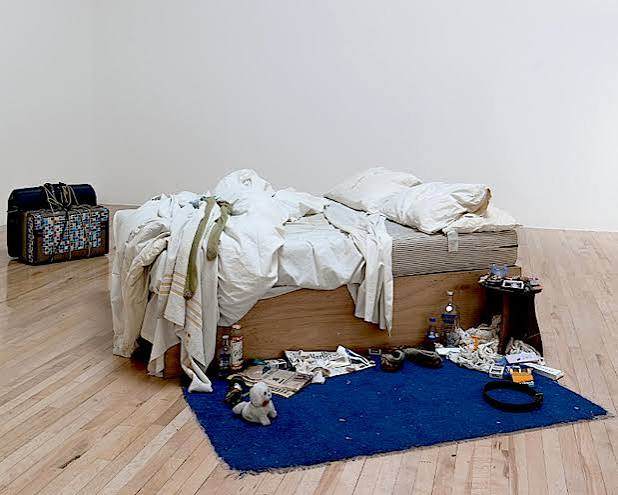
My Bed,Tracey Emin, bedding
1998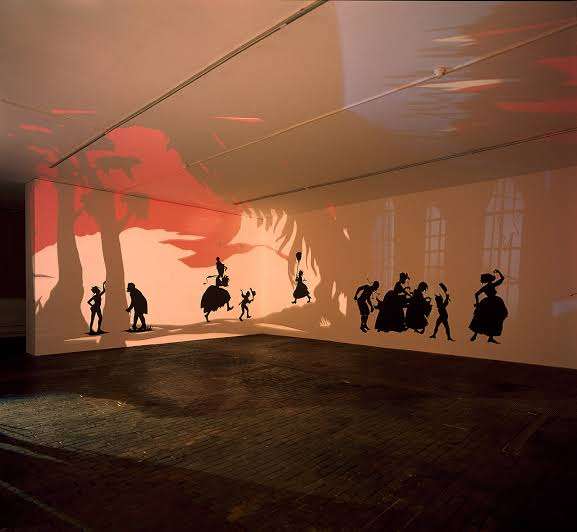
Insurrection! (Our Tools were Rudimentary, Yet We are Pressed on), Kara Walker, cut-paper silhouettes
2022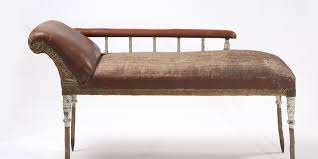
The Chase, Julie Gough, Installation / mixed media
2008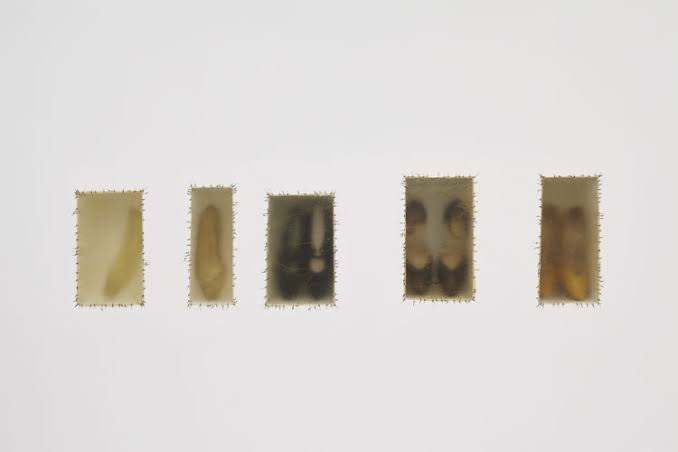
Atrabilarios, Doris Salcedo, Drywall and shoes
1992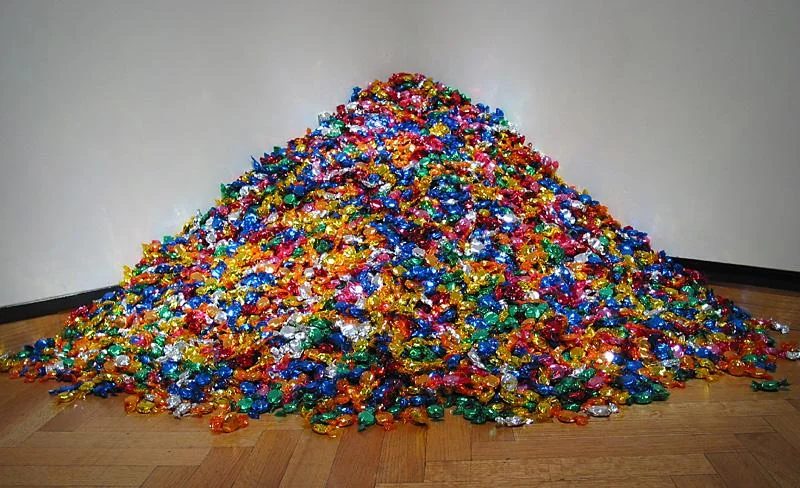
”Untitled”(Portrait of Ross in L.A),Felix Gonzales-Torres, endless supply of candy
1991Immersive Experience
Walk through this gallery in 3D
Step inside a virtual gallery space. Walk up to each artwork. See them as they were meant to be seen.
React to this gallery
Guestbook
Sign in to leave a comment.
Loading…
Galerra
Create your own exhibition
Upload your work and we build a walkable 3D show in about a minute. Free to start.