

Artworks
- Sunflower Seeds, Ai Weiwei, 2010. Porcelain. (2010) — Sunflowers Seeds by Ai Weiwei is a piece produced by an additional 1,600 artisans. Within the span of 2 years, 100 million seeds are handcrafted, carved, and painted with small porcelain pieces, a cultural material and symbol of Chinese art. The seeds themselves were meant to represent sunflowers turning toward Mao, the sun. Designed to be similar and through rigorous work, they reflect on the forced similarities placed on citizens and the erasure of individuality. Their large number dictates China’s entry into mass production. No individual seed can be recovered from the pile, no maker identified, no name. 100 million seeds, each reflecting those with a similar face.
- Untitled, Felix Gonzalez-Torres, 1991. Candies in variously colored wrappers, an endless supply. (1991) — Untitled enters the exhibition's most direct implication of the viewer in its argument. It features 175 pounds of multicolored candy, signifying the loss of the artist's lover, Ross Laycock. Gonzalez-Torres makes the viewer cause the disappearance, experiencing someone's identity fade in real time. The state's silence around AIDS was not passive neglect but a policy decision that refused aid to thousands, and this work makes that mechanism experiential rather than documented. Erasure is enacted in a gallery, one piece at a time, by ordinary hands. Placed between Remembering and Sunflower Seeds, it bridges the exhibition's movement from public documentation to systemic abstraction, each piece of candy acting as the removal of the body and name. Wu Hung's politics of invisibility is seen in the American state's silence around the LGBTQ, operated by the same logic as an authoritarian state's suppression of civilian testimony. Gonzalez-Torres does this not through accumulation or architecture but through sweetness. With an unrecorded identity, a pattern emerges.
- Remembering, Ai Weiwei, 2009. 9,000 Children's Backpacks. (2009) — Remembering by Ai Weiwei, designed in 2009, speaks loudly against government censorship. Nine thousand backpacks are stacked on top of each other. Their colors are varied: red, blue, yellow, green. Each represents a child lost in the tragedy of the poorly constructed school buildings that collapsed during the 2008 Sichuan earthquakes, a count that the state refuses to record. A mother's voice, in a single sentence, “She lived happily for seven years in this world”, conveys the sadness each victim's family feels. The result is a work that operates simultaneously as a memorial, a political indictment, and a formal argument. The installation had to be built in Germany rather than China, as its final statement. The erasure it documents will be toppled if constructed in Weiwei’s birth country.
- Voiceless Cries (2026) — What remains of a life, a name, a body of grief, when the machinery of power moves to erase it? These are the questions at the center of Voiceless Cries, an exhibition that gathers five works made in response to political silencing, each one an act of making visible what those in power worked hard to keep hidden. The artist Ai Weiwei says, “Everything is art, and everything is politics.” Meaning that the choice to create, to name, to show a face or count a number, is already a refusal to go along with those who prefer conformity over aid. It means that silence in the face of harm is itself a political position, one that the state relies on and benefits from. The five works gathered here operate from exactly this understanding. They are political acts that take the form of art. Art historian Wu Hung has written about how post-Tiananmen Chinese art is shaped by what he calls a politics of invisibility, a system of deliberate blind spots built into culture that renders certain events, people, and truths unspeakable. The artists in this exhibition push back against that system by constructing what is called counter-legibility, a way of making the hidden seen again. The exhibition moves from the loss of a single person to the slow disappearance of the individual inside the mass. Opening with Untitled by Felix Gonzalez-Torres, it’s designed as a mural made in grief for a person the government refused to help, refused to acknowledge, and, in that refusal, erased. Placed at the beginning of the exhibition, it establishes the core pattern the other works will return to: that erasure begins with one person, one name, and continually spreads outwards to the mass. Remembering by Ai Weiwei carries that logic to a larger scale. Nine thousand backpacks cover the face of a building, one for each child who died in a preventable collapse, each child whose name the state refused to record. The sheer number is the piece’s goal for viewers to recognize. The state's erasure of these children required repetition, applied one life at a time, and the work refuses to let that repetition remain invisible. Sunflower Seeds, another piece by Ai Weiwei, shows what erasure looks like when it is slow and structural rather than sudden. Millions of hand-painted ceramic seeds, each one distinct and yet absorbed into an undifferentiated mass, show how a citizen disappears not through an act of violence but through the gradual pressure of conformity, one person becoming indistinguishable from the next. Mask Series No. 6 by Zeng Fanzhi moves this pressure inward. Where the seeds showed what erasure does to a crowd, the masked figures here show what it does to a face, to a self. The blank surface where expression connects directly to the anonymity of the seeds. What remains of a person when they are required to show nothing? Garbage Hill by Yue Minjung gives the answer. The faces here show nothing. They perform happiness over buried pain. The forced smile is the final stage of erasure, the moment when the survivor is made to confirm the story that nothing happened. These serve as testimony to a cause that the government has forgotten, but the people have not.
- Garbage Hill, Yue Minjun, 2009. Lithograph. 80 x 120 cm
- Mask Series, No.6, Zeng Fanzhi, 1996. Oil on canvas. 200 x 360 cm. (1996) — Mask Series No. 6 by Zeng Fanzhi moves the exhibition's central argument from the public into the body itself. Instead of repeating Ai Weiwei’s large-scale works, Zeng Fanzhi narrows it to eight figures in a room. Young adults are beside each other, with masks, forced to hide their true selves within. The wide grins affixed to the masks show their forced compliance with the government's conformity. The work makes visible what the government's demand for conformity costs at the most intimate level, the face. The yellow ground and group composition position this not as individual psychology but as collective. The masks serve as replacements rather than concealing their faces, suggesting that identity is not suppressed but replaced with an approved version. It’s their last resistance, their final testimony before reaching full conformity. Having a relatable connection to Ai Weiwei’s Sunflower Seeds shows the imposed similarity between them, a lack of individuality at the hands of the state.
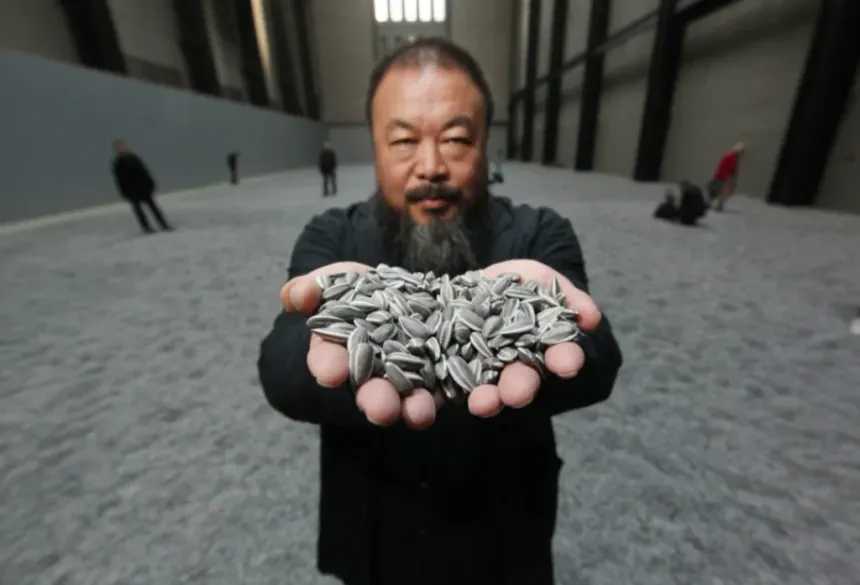
Sunflower Seeds, Ai Weiwei, 2010. Porcelain.
2010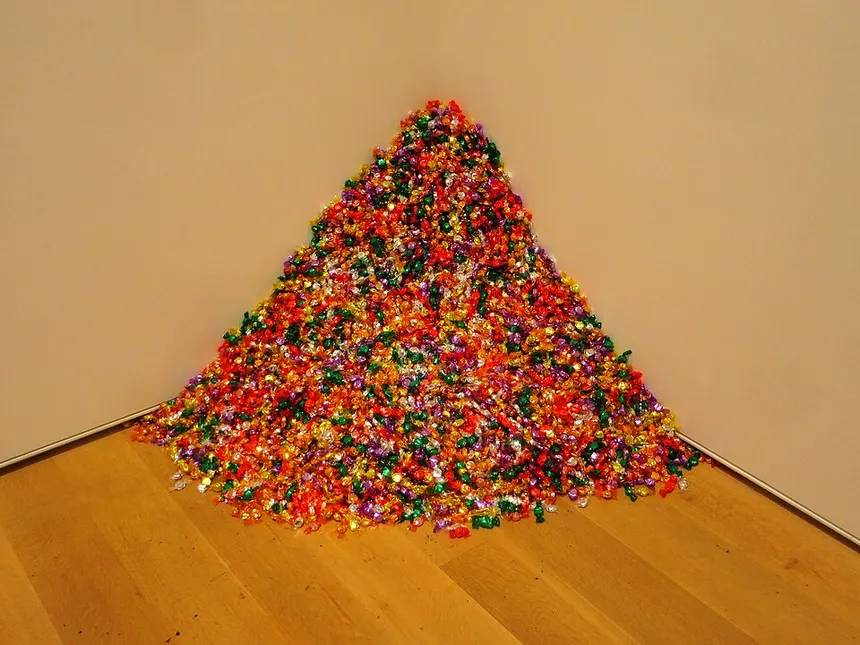
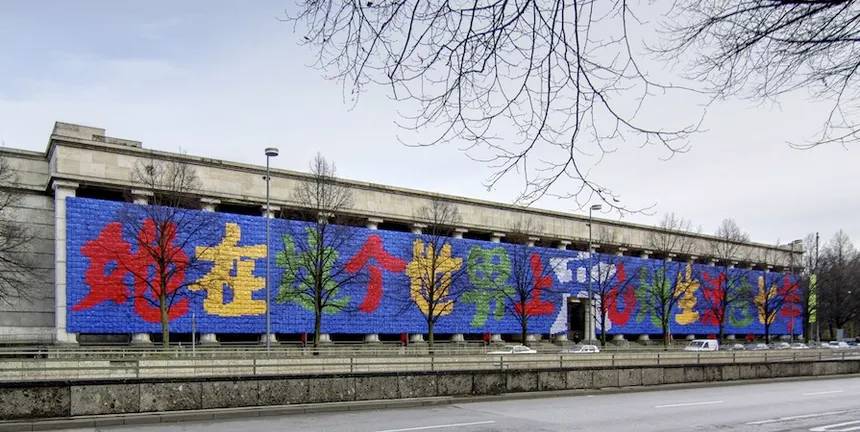
Remembering, Ai Weiwei, 2009. 9,000 Children's Backpacks.
2009
Voiceless Cries
2026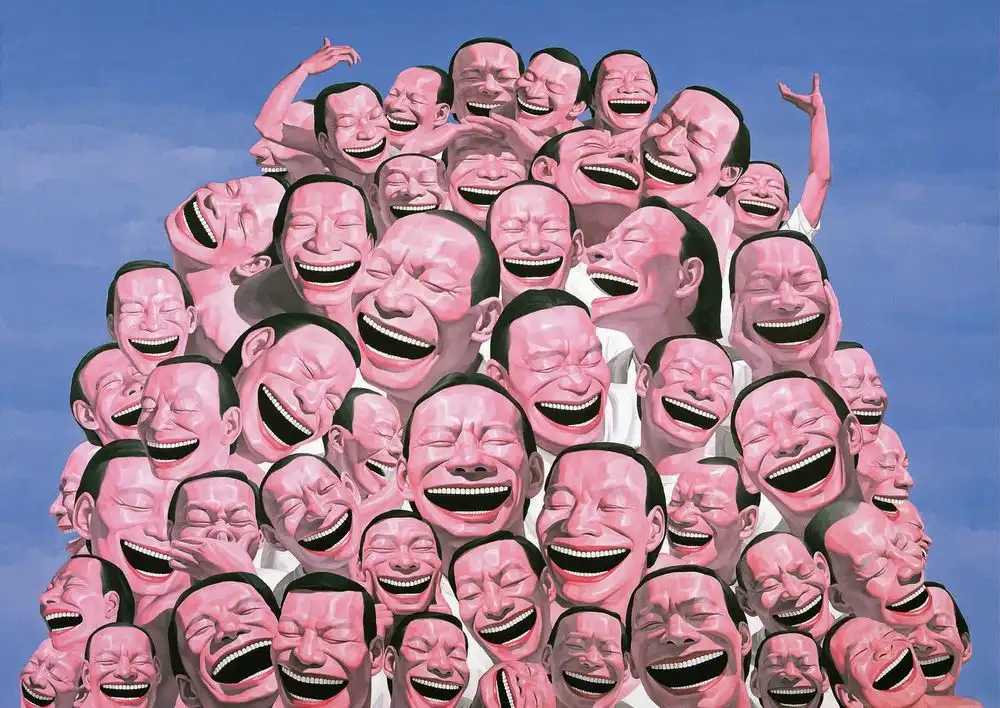
Garbage Hill, Yue Minjun, 2009. Lithograph. 80 x 120 cm
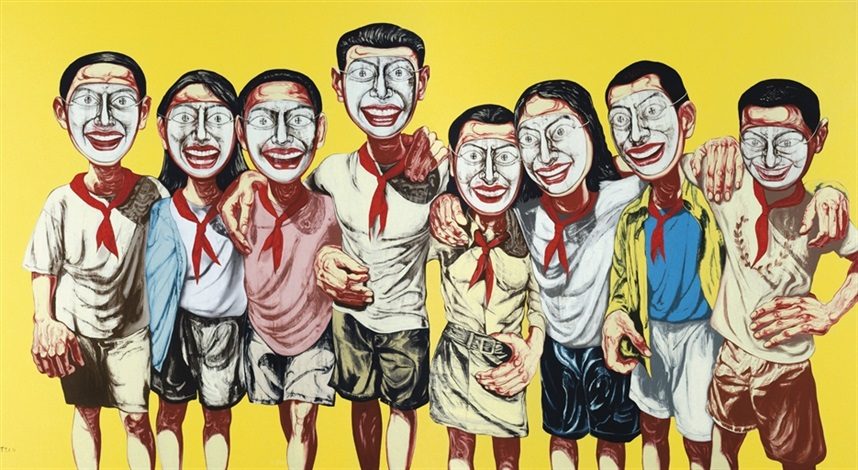
Mask Series, No.6, Zeng Fanzhi, 1996. Oil on canvas. 200 x 360 cm.
1996Immersive Experience
Walk through this gallery in 3D
Step inside a virtual gallery space. Walk up to each artwork. See them as they were meant to be seen.
React to this gallery
Guestbook
Sign in to leave a comment.
Loading…
Galerra
Create your own exhibition
Upload your work and we build a walkable 3D show in about a minute. Free to start.