
Who Gets to Be Seen? Identity, Power, and Representation
Artworks
- Le déjeuner sur l’herbe: Les Trois Femmes Noires (2021) — Mickalene Thomas Rhinestones, acrylic, and enamel on wood panel, 120 × 288 × 2 in. (304.8 × 731.5 × 5.1 cm). Le déjeuner sur l’herbe: Les Trois Femmes Noires places three fully dressed Black women at the center of a huge patterned surface, where their direct gazes, large scale, bright colors, repeated prints, and reflective rhinestones make them visually dominant. Thomas deliberately reworks Manet’s famous composition, but replaces its gender and racial relationships with women who occupy the space on their own terms. Her use of the Western canon gives the formal composition historical weight, while the women’s clothing, posture, and gaze change who controls the image. The work closes the exhibition by turning representation into reclamation: Black women are not inserted at the edge of art history but placed at its center, looking back.
- mistikôsiwak (Wooden Boat People): Resurgence of the People (2019) — Kent Monkman (Cree) Acrylic on canvas, 132 × 264 in. (335.3 × 670.6 cm). Resurgence of the People shows a crowded Indigenous community moving through rough, polluted water with Miss Chief standing prominently near the center. Bright color, overlapping figures, repeated paddles, multiple focal points, and strong diagonals create movement while distributing attention across the community rather than limiting it to one leader. The work was created for The Met as part of Monkman’s larger practice of challenging colonial history painting and re-centering Indigenous experience. By placing women, children, elders, same-sex parents, Two Spirit identity, traditional clothing, and contemporary clothing inside a monumental history painting, Monkman connects the visual structure to a message of survival and mutual aid. The painting replaces the old story of Indigenous disappearance with a community that is present, diverse, and actively guiding itself forward.
- Study for Blue Water, Silver Moon (1991) — Kerry James Marshall Conté crayon and acrylic on paper, 49 3/4 × 38 1/8 in. (126.4 × 96.8 cm). Study for Blue Water, Silver Moon presents a large dark-skinned mermaid whose body dominates a pale, loosely drawn setting. The strong value contrast, large scale, direct gaze, and extended arm make the figure visually unavoidable, while repeated horizontal marks connect her body to the surrounding water. Marshall’s broader practice centers Black figures within traditions of Western art and culture that often treated whiteness as the default. By using a mythological figure commonly associated with idealized white beauty, he turns the formal emphasis of the composition into a question about visibility and cultural standards. The work places Black beauty at the center of the image and makes the viewer confront how racial expectations shape what is treated as familiar, ideal, or universal.
- Contour of Loss (2020) — Titus Kaphar Oil on canvas, 66 × 60 in. (167.6 × 152.4 cm). Contour of Loss presents a Black mother facing the viewer while holding the literal cut-out shape of a missing child. The saturated blue-purple palette, frontal figure, encircling arms, bright white absence, and physically removed canvas make the missing child the dominant focal point. Kaphar draws on the visual traditions of Renaissance and Baroque madonnas and pietàs while centering a Black mother with her own child, and The Met connects the excision to gun, police, and environmental violence affecting Black communities. The formal removal of the canvas becomes part of the meaning: the work does not simply describe loss but makes absence occupy real physical space in the picture.
- The Chase (2008) — Julie Gough (Trawlwoolway) Found chaise lounge, leatherette, steel pins, and burnt tea-tree sticks. 97 × 182 × 52 cm. Julie Gough’s The Chase is a dark chaise lounge covered with pinned text and supported by burnt tea-tree sticks instead of ordinary legs. Its long horizontal shape, repeated pins, rough supports, and contrast between soft upholstery and sharp materials keep the historical text physically tied to the object. Gough’s practice centers on recovering suppressed Tasmanian Aboriginal histories, and this work uses an 1830 colonial newspaper account describing Aboriginal people being pursued and captured. The visual tension between a familiar piece of furniture and materials that make it unstable connects the object’s appearance to that history. Together, the domestic form, archival text, and altered supports turn a symbol of comfort into a reminder that colonial comfort was built alongside violence and displacement.
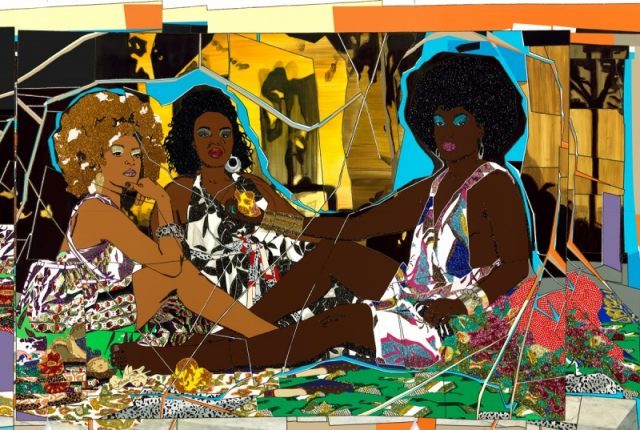
Le déjeuner sur l’herbe: Les Trois Femmes Noires
2021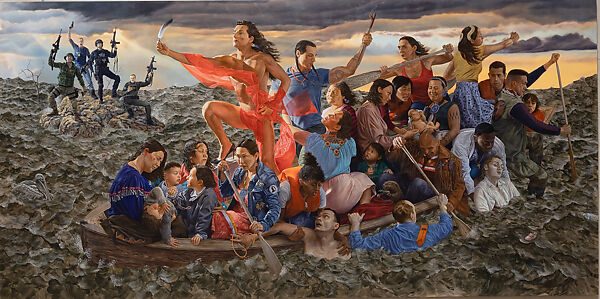
mistikôsiwak (Wooden Boat People): Resurgence of the People
2019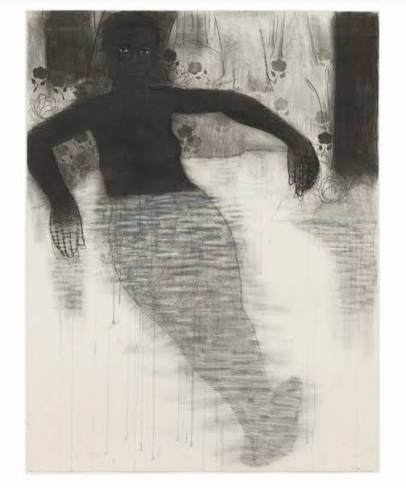
Study for Blue Water, Silver Moon
1991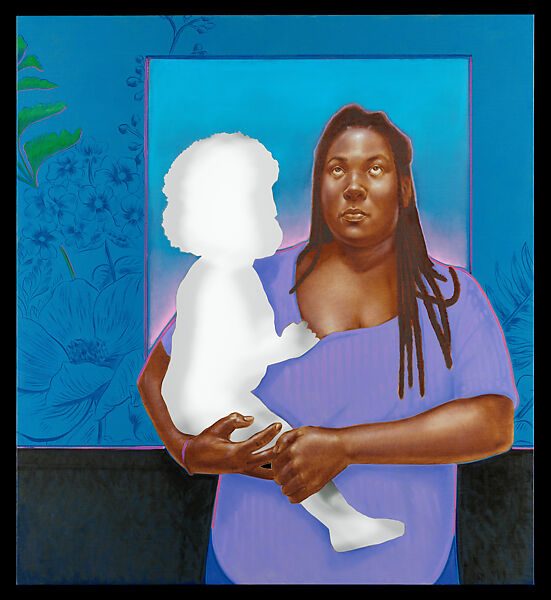
Contour of Loss
2020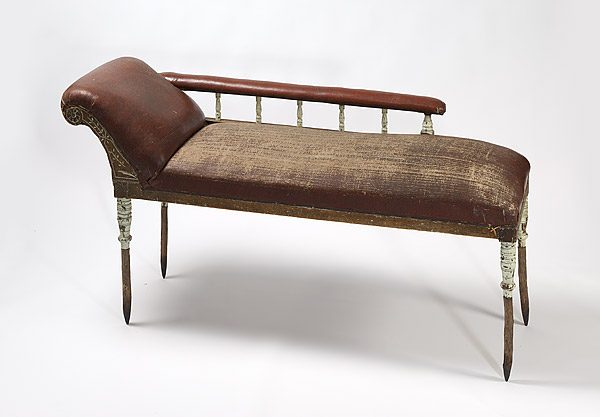
The Chase
2008Immersive Experience
Walk through this gallery in 3D
Step inside a virtual gallery space. Walk up to each artwork. See them as they were meant to be seen.
React to this gallery
Guestbook
Sign in to leave a comment.
Loading…
Galerra
Create your own exhibition
Upload your work and we build a walkable 3D show in about a minute. Free to start.