Explore 3D Virtual Art Galleries
Browse 321 virtual art galleries on Galerra. Walk through immersive 3D exhibitions featuring photography, digital art, traditional art, and more.
Featured galleries
- المعرض الإلكتروني لطالبات الابتدائية ١٩٥ — 10 views
- Oumba-ry — 10 views
- Traces of Humanity in Nature — 9 views
- עטור מצחך — 9 views
- Entre altares y los andes — 9 views
- DIMITRIS's Gallery — 8 views
- Yasaman's Gallery — 8 views
- Symbolic Identity in Buddhist Art: From Absence to Enlightenment — 8 views
- Native American Self-Representation of Life, Community, Culture, and Resistance Against the Colonial Gaze. — 8 views
- Power and the People — 8 views
- The canvas within — 8 views
- From Body to Mind: The Idealized Human Figure — 8 views
Discover
galleries.
Walkable 3D exhibitions by artists worldwide. Click any to step inside.
Create your own — free
Traces of Humanity in Nature
Traces of Humanity in Nature exhibit explore how artist from China and India use nature and landscape to represent human identity, memory, experience, and voices. These selected artworks present more than just nature; rather, it presents mountains, animals, seeds, and physical spaces that carry cultural meaning and oppression. A few artists will place human figures directly on a landscape while others will add human presence through symbols, sculptures, handmade objects, or voices. The exhibit will begin with a traditional Chinese landscape known as Travelers Among Mountains and Streams. The painting captures nature at its finest with a space for spiritual reflection and humanities place in a much larger world. All while transitioning into artwork that spans between different mediums, time periods, cultural context, all while focusing on identity, political history, and commination. Additionally, they use the human presence to show that we have power whether it is through memory, society, oppression, and nature. "Tradition is only a readymade. It's for us to make a new gesture — to use it as a reference, more as a starting point than conclusion” (Japantimes). This quote is from Ai Weiwei in an article titled “Escape from propaganda,” and he is showing that these cultural traditions are treated in a fixed manner, making it seem unchangeable. Instead, these cultural traditions are served as a foundation for reinterpretation and can be given a new meaning by each new generation. This quote serves as a connection to this exhibit because each selected artwork engages with cultural tradition, history, and human experience. Fan Kuan’s artwork reflects Chinese tradition about humanity's relationship with nature. Ai Weiwei, Zhanf Huan, and Shilpa Gupta artworks revisit cultural events, landscapes, symbols, and memories to address modern day concerns that may not have existed back then. Thus, showing that these artworks demonstrate that traditions are continuously reinterpreted rather than being preserved and fixed. This exhibit will start with a traditional Chinese landscape painting that date back all the way to the Northern Song dynasty. Travelers Among Mountains and Streams dives into the idea of balance, and spiritual harmony by showing humanity’s small place within nature. Then we will shift towards a reinterpretation large scale sculpture made up of bronze. The Circle of Animals/Zodiac Heads is inspired by the original 12 sculpture that was once a part of a fountain in Beijing, China. Though they were looted during the second opium war, only seven of them survived. The artist Ai Weiwei made the 12 sculptures and reimagined the missing five which questioned cultural history as it may have some reconstructed history. Ai Weiwei second appearance comes from his Sunflower Seed art as it focuses on collective identities of millions of individuals as they were each represented by a handcrafted porcelain seed. These seeds symbolize individuality within a society. Then we will transition into a performance act caught in photograph that brings the physical body of humans into nature. To Add One Meter to an Anonymous Mountain presents multiple artists stacking themselves on a mountain to alter nature itself only for a moment. The final artwork for this exhibit will examine will explore exclusion and communication. For, In your Tongue, I Cannot Fit will be the concluding artwork where we shift towards social and political structures as it questions identity, voice, and oppression.

עטור מצחך

גלריה זאת מציגה תמונות אשר ממחישות ומראות את השיר "עטור מצחך" מאת אברהם חלפי. הן הופכות את מילות השיר למשהו ממשי, נותנות לנו עוד דרך לחוות את מסר ומשמעות השיר. על ידיהן אנחנו יכולנו לחוות את הרגשות שמנסים להעביר לנו דרך תמונות, בצורה מפושטת יותר. לכל תמונה בגלריה יהיה הסבר ופירוט לקשר השיר, אם תרצו לקרוא רק לחצו על התמונה.

Symbolic Identity in Buddhist Art: From Absence to Enlightenment

This exhibition shows how identity in Buddhist art is shown without representing the human self. Instead of presenting the Buddha as an individual, the Buddhist visual culture communicates spiritual identity through symbolism, gesture, material form, and many times through absence. Across sculpture and architecture from Southeast Asia, the Buddha is as a trace of enlightenment that exists in space, posture, and sacred form. This idea can be understood through representation working as symbolic presence rather than visibility. As Ananda Coomaraswamy says, “The Buddha is not represented as a man, but as an idea beyond man.” Because of this, Buddhist imagery shifts focus away from physical identity and more toward spiritual realization. This can be seen as where enlightenment can’t be contained in one human form. Instead, it is shown through things like the stupa, mudras (hand gestures), meditative bodies, or even the complete absence of the body. The exhibition starts with the Great Stupa at Sanchi, where the Buddha is not shown at all. Instead, the idea of presence is in architecture and the way the space is structured, suggesting enlightenment through movement and direction rather than a figure. It sets up absence as a form of representation, where meaning comes from structure and ritual rather than the human body. This idea continues in the Standing Buddha, where the body appears but is still not individualized. Posture and mudras show calmness and authority, showing identity through controlled presence rather than personal features. In the Seated Buddha from Ajanta, the body is focused on meditation. Identity is shown through stillness, where enlightenment is represented as inner calm instead of outward individuality. The Buddha Head from Gandhara goes further by removing the body completely and focusing only on the face or head, where expression and serenity become the main way identity is shown. It also reflects how Buddhist art changes across regions and influences. The exhibition ends with the Reclining Buddha at Wat Pho, where the body is laid out horizontally, showing the Buddha entering Nirvana. Overall, these works show that Buddhist art doesn’t rely on direct depiction of identity but instead builds meaning through symbolic absence and spiritual suggestion. Across the gallery, the Buddha becomes less of a person and more of a presence that exists beyond what you can physically see.

Power and the People
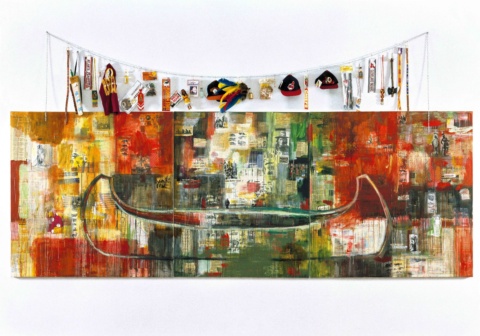
Power is often talked about through governments, political leaders, and major historical events, but the people who are most affected by it are often ordinary individuals just trying to live their lives. This exhibition explores how systems of power shape human experiences through segregation, social conflict, colonization, political oppression, and war. Rather than focusing on the people who create or hold power, these artworks focus on the people who have to live with the consequences of it. Together, they ask viewers to think about how authority is created, how injustice is maintained, and how people respond through survival, resistance, and resilience. Ai Weiwei once said, "Everything is art. Everything is politics" (Art21, 2011). I think this quote connects well to this exhibition because all of these artworks show that politics are not separate from everyday life. Decisions made by people in power affect where people can go, how they are treated, what stories are remembered, and sometimes whether entire communities survive. Even though these artworks were created in different countries and time periods, they all show the impact that power and injustice can have on ordinary people. The exhibition begins with Norman Rockwell's The Problem We All Live With. By focusing on Ruby Bridges as a child walking to school, Rockwell shifts attention away from legal debates about segregation and instead shows what those decisions looked like in one person's everyday life. Faith Ringgold's The American People Series #20: Die expands that focus by showing the violence and division that can grow within communities affected by larger social tensions. Rather than offering a clear answer or someone to blame, Ringgold forces viewers to sit with the human cost of conflict. Kent Monkman's mistikôsiwak (Wooden Boat People): Resurgence of the People shifts the conversation toward Indigenous experiences of colonization. Instead of celebrating leaders or conquest, Monkman focuses on families, elders, children, and communities trying to survive together. The painting highlights both the damage caused by colonization and the resilience of the people who continue to endure it. Yue Minjun's The Execution explores another response to power by focusing on the emotional and psychological effects of oppression. The laughter in the painting feels uncomfortable because it makes it difficult to know what the figures are actually feeling. It suggests that people do not always show fear or respond to injustice in obvious ways. The exhibition concludes with Pablo Picasso's Guernica, one of the most famous anti-war paintings in history. Instead of focusing on military victory or political leaders, Picasso emphasizes fear, grief, and suffering. The people in the painting are left to deal with the consequences of violence and decisions made by those in power. I arranged these artworks to move from individual experiences of injustice toward broader examples of conflict and oppression while keeping people at the center of each story. Even though the situations are different, all of these works remind us that real people are the ones living with the consequences of decisions made by others. They also show the strength people can have through survival, resilience, and resistance, even during some of the most difficult circumstances.

From Body to Mind: The Idealized Human Figure
Throughout Greek and Renaissance art, the human figure became one of the primary ways artists expressed cultural values, beliefs, and ideals. This exhibition explores how artists used the idealized body to represent many different forms of the human excellence. While many of these works focus on physical beauty, strength, and proportion, they also reveal changing ideas about what it means to be an ideal human being. Rather than simply depicting real people, these artists created figures that embodied qualities their societies admired and sought to emulate. One theoretical framework that helps explain this process is Aristotle's concept of mimesis. Aristotle argued that art imitates reality, but artists do not merely copy the world around them. Instead, they often create idealized versions of reality that communicate larger truths and values. This idea can be seen throughout Greek and Renaissance art, where artists carefully studied anatomy, movement, proportion, and beauty while presenting figures that appear more perfect than ordinary people. Through mimesis, the human body becomes a vehicle for expressing cultural ideals. The figures selected for this exhibition are not just ordinary representations of humans. Instead, they represent different forms of perfection that each culture valued. Some artwork emphasize the athletic excellence and the physical strength, while other artworks focus on beauty, harmony, wisdom, or intellectual achievement. Although the artworks differ in medium, subject matter, and historical context, they are all connected by their use of the human figure as a symbol of cultural ideals. By examining these artworks together, this exhibition explores how artists used the human body to communicate broader ideas about what humanity should or could aspire to become. This exhibition begins with the artwork Polykleitos' Doryphoros, which establishes the Greek ideal of athletic perfection through balance, symmetry, and proportion. The sculpture presents a model of physical excellence that would influence artists for centuries. Michelangelo's David follows and demonstrates how the Renaissance arts revived classical ideals while also combining them with humanism and the individual achievement. Together, these artworks explore masculine perfection through strength, discipline, and human potential. The Birth of Venus introduces a different form of idealization. Botticelli shifts the focus from athletic power toward beauty, grace, and femininity. While the figure remains idealized, the meaning of perfection expands beyond physical strength. Leonardo da Vinci's Vitruvian Man then transforms the body into an object of scientific observation and mathematical inquiry. Here, perfection is connected to proportion, reason, and universal harmony rather than mythology alone. This exhibition concludes with Raphael's The Schools of Athens. Although the figures remain idealized, they are primarily for their wisdom and intellectual achievement. The focus moves from the perfection of the body to the perfection of the mind. By presenting the works in the sequence, the exhibition traces a progession from physical excellence toward the intellectual excellence. Ultimately, these artworks demonstrates that while definitions of perfections changed between Greek and Renaissance cultures, the idealized human figures remained one of the most powerful ways artists explored what humanity could become.